The ideation workshop pointed to three main needs: clearer direction and prioritization, support for boundaries and saying no, and better delegation, communication, and follow-up. These are practical needs, but they also show something larger. The design can’t simply be a planner, a template, or a digital tool. It needs to become a small self-leadership-learning ecology: something that helps the leader learn new ways of working while actually doing his everyday work.
My first design principles were quite broad. They focused on the local context, the wider ecology of support, transferability, and the importance of coaching and reflection.
After the ideation workshop I realized the design still needs to be context-sensitive and postdigital, but it also needs to be more practical and more focused on learning through use. The leader does not only need tools, he also needs support in learning how to use tools and routines in a way that fits his actual work life.
This matters because I don’t want to design for an ideal user with stable internet, plenty of time, and previous experience with productivity systems. I want to design for the real conditions of local nonprofit leadership: interruptions, limited resources, mixed communication channels, uneven digital access, and many competing responsibilities.
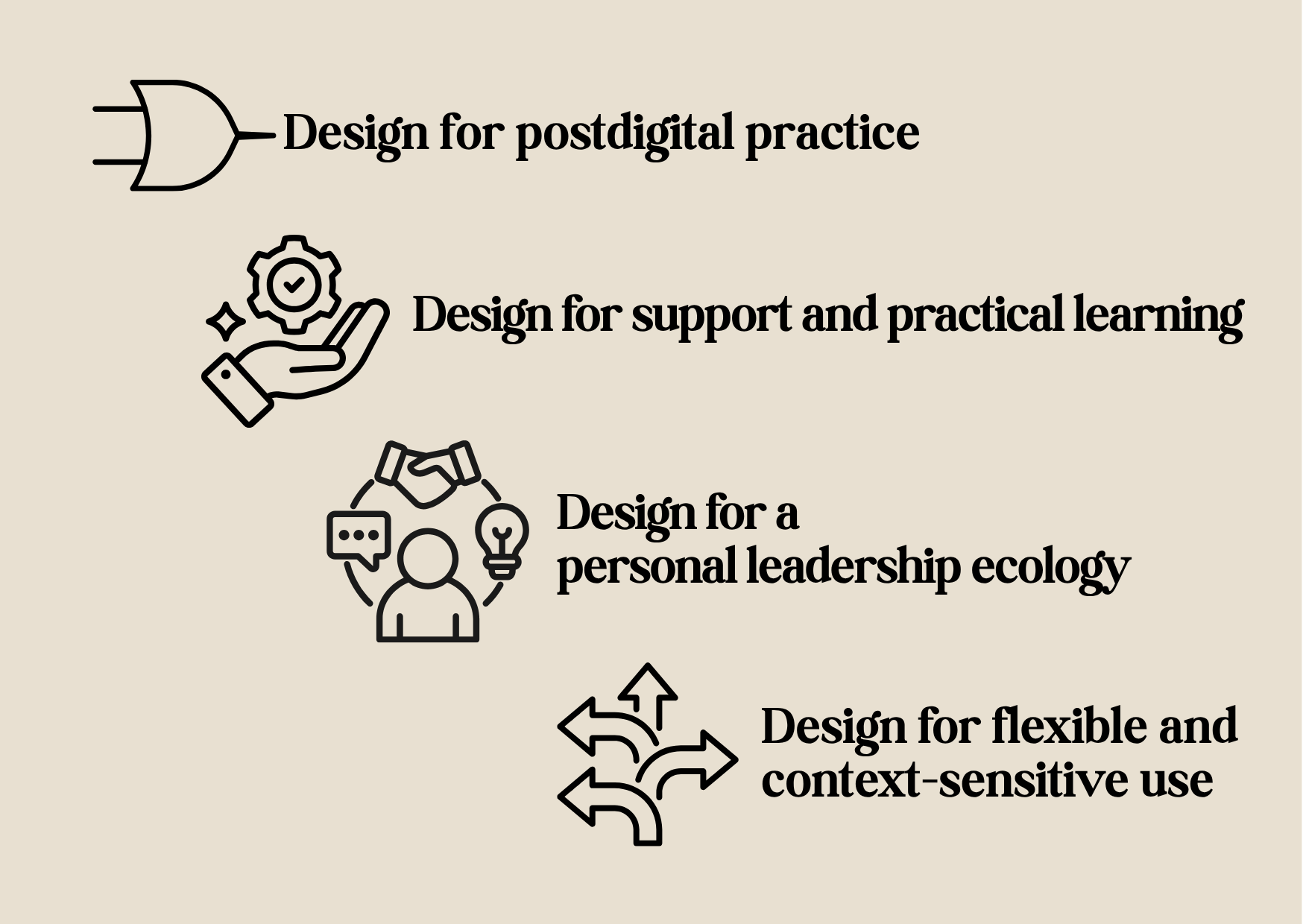
This has led me to four revised design principles.
#2.1: Design for postdigital practice, not digital tools alone
The design should not treat the digital as a separate solution. It should connect digital tools with paper-based supports, physical routines, conversations, and reflection.
This principle comes directly from the ideation process itself. The workshop did not unfold through one smooth digital platform, but moved between Zoom, screen sharing, spoken facilitation, and a shared document. In the same way, the design should not depend on one perfect tool. It should work with the mixed digital, material, and social reality of the leader’s everyday work.
#2.2: Design for support and practical learning
The design should not assume that the leader already knows how to use productivity methods, planning templates, or digital workflows. Instead, it should help him gradually explore, adapt, and make the tools his own.
This principle became clearer during the brainstorm. Tools and templates were mentioned several times, but always alongside a broader desire for practical learning. The design should therefore support the leader in exploring and experimenting while building his personal leadership learning ecology.
#2.3: Design for individual learning in a personal leadership ecology
The design should support the leader’s individual learning over time. It should function as a practical home base for developing self-leadership through planning, reflection, experimentation, and follow-up.
This principle helps keep the focus clear. In the ideation workshop, the leader expressed a clear wish to develop his personal leadership. He identified “saying yes to everything” as his biggest challenge and connected it to a need for stronger self-leadership. At the same time, his leadership is always practiced in relation to others: employees, board members, donors, and beneficiaries. The design should therefore support his individual learning and self-leadership, while still recognizing the relational nature of his work.
#2.4: Design for flexible and context-sensitive use
The design should be usable under uneven and changing conditions. It should work when the internet is unstable, when time is limited, and when work moves between online and offline spaces.
This principle is important because the ideation workshop showed that the design cannot rely on ideal conditions. It should be flexible enough to move between digital and analogue formats, and simple enough to remain useful across different working conditions.
The ideation phase helped me see that the design should not be a finished system handed over to the leader. It should be something he can grow into, test, adapt, and make his own.
For me, this is where the postdigital perspective becomes practical. It is not only a theory about digital and non-digital learning. It is a way of designing for real life: where tools fail, people improvise, learning continues, and good design has to move with the situation.
My next step is to turn these principles into a first prototype. The challenge will be to make something simple enough to use, but rich enough to support real learning and change over time.
Skriv et svar
Du skal være logget ind for at skrive en kommentar.