Designing for Stronger Local Leadership: A Postdigital Design Challenge
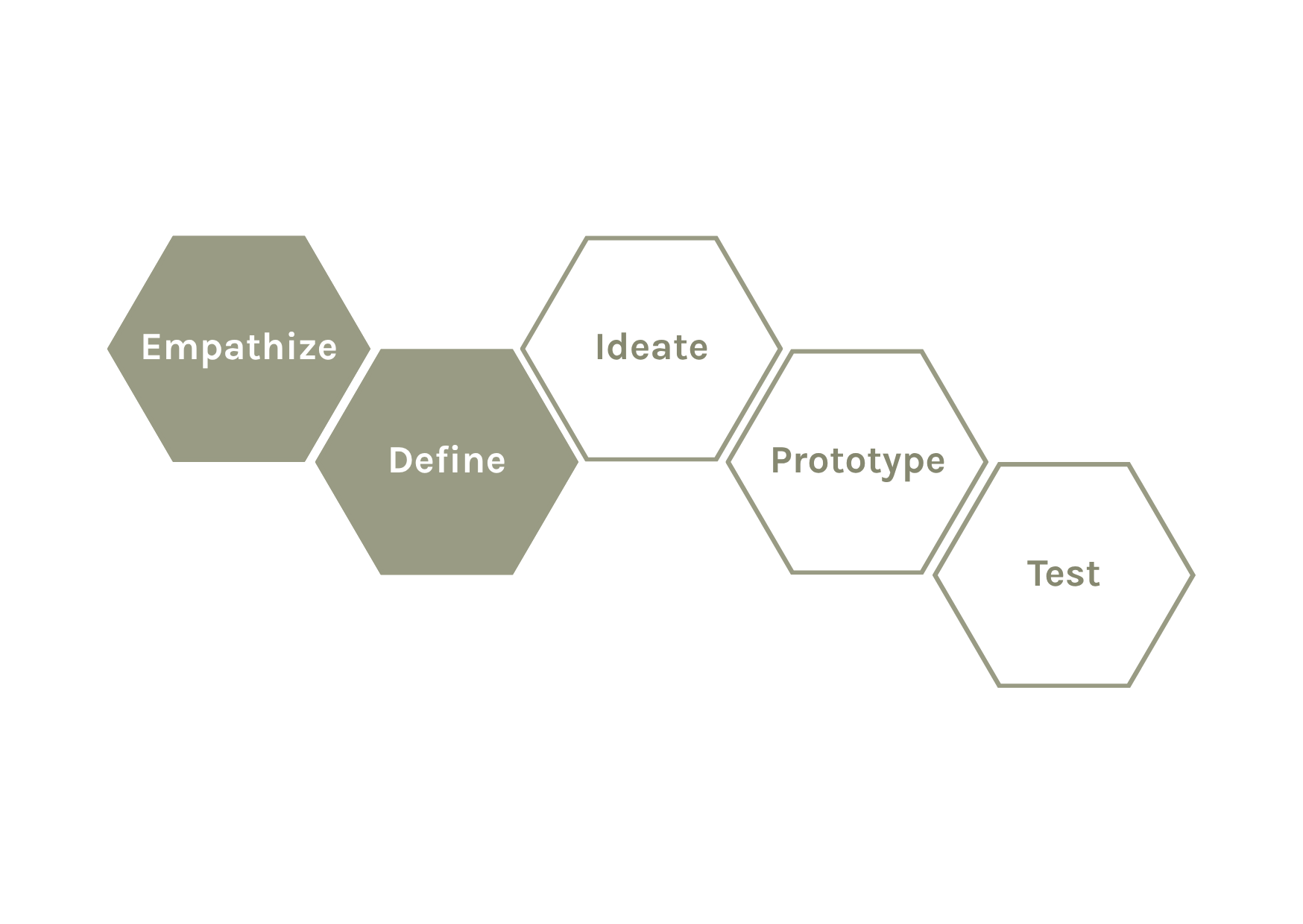
For this design project, I have chosen to work with the Stanford model of design thinking because it offers a clear and human-centered way of moving from understanding a real context to developing possible design responses. In this blog post, I focus on the first two phases of the model: Empathize, where I explore and understand the user’s situation, and Define, where these insights are shaped into a more focused design challenge.
Empathize
In the Empathize phase, my goal has been to understand the everyday reality of the person and practice I am designing for. This is not only about collecting opinions, but about paying attention to the gap between what is said, what is done, and what the wider context makes possible.
My empathy work has centered on an exploratory case study of a local nonprofit leader in Nigeria who works in partnership with a nonprofit organization in Denmark. Its purpose was to generate insight into what it means to be a local nonprofit leader and to better understand the challenges and opportunities that may arise when leaders in the Global South collaborate with organizational partners in the Global North.
To better understand this context, I have drawn on qualitative interviews, document analysis, and The Culture Map by Erin Meyer as an analytical lens. The findings were gathered in an empathy map in Miro as a visual synthesis tool to organize and interpret insights from the empirical investigation:
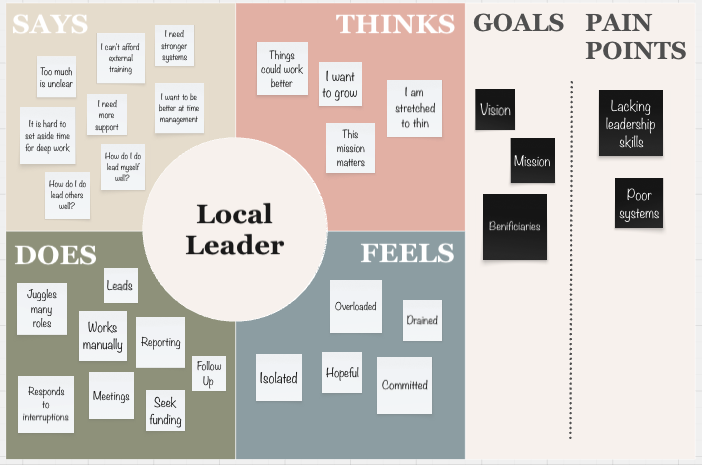
What began to emerge was a picture of a leader who is deeply committed, values-driven, and motivated by the mission of his organization, but who is also carrying significant responsibility under difficult structural conditions. A key finding from the case interviews concerns self-leadership:
“I want to get better at scheduling. I don’t think my current system is effective. I also want to have the discipline to stick to what I have scheduled.”(…)“I want to understand better how to follow up.” – Nigerian nonprofit leader.
For the local leader the area of personal productivity seems to be a focus area for growth. However, both The Culture Map and the interviews show cultural differences of how work is done in Nigeria versus Denmark. In this case, the Danish side tends to work with stronger expectations around calendars, deadlines, and step-by-step planning, while the Nigerian context appears more flexible and reactive. This does not mean that one approach is better than the other. Rather, it suggests that any design should be grounded in the local Nigerian leadership context instead of being built on imported assumptions about how work “should” be organized.
Define
The Define phase is where empathy begins to take shape as direction. After exploring the context more openly, I now need to ask: what is the actual challenge this project should address?
What stands out most clearly in my case is a repeated tension between strong motivation and weak systems. The leader wants to become better at scheduling, follow-up, and everyday structure, but his current workflow depends on a patchwork of tools and habits: calendar use, paper notes, weekly review practices, wall planning, and retrieving documents through email threads. This suggests that the problem is not simply that there is “no system,” but that the existing system is fragmented, difficult to sustain, and hard to build on over time.
The literature review helped sharpen this understanding even further. Across the sources I have reviewed, three themes stand out. First, leadership development needs to be context-sensitive. Second, it has to be understood as more than technical training. Third, it should be designed as a social and postdigital process shaped by people, tools, practices, and material conditions. In this case, that is especially important because the leader is also in transition toward building a new nonprofit initiative. The design therefore needs to be useful in his current work, while also being transferable enough to support him in a new organizational setting.
From this case study, I have formulated the following design challenge:
How might I design a postdigital leadership-learning ecology that supports self-leadership, follow-up, and reflection in current nonprofit work and through a transition toward building a new nonprofit initiative?
And the following research question:
How can a postdigital support ecology of digital tools, material artefacts, and relational practices strengthen self-leadership and everyday workflow for a local nonprofit leader in transition?
Together, the design challenge and research question reflect a shift in how I understand the project. Rather than seeing leadership support as an individual problem to fix, I am beginning to see it as something shaped by tools, routines, relationships, and context. In my next post, I will build on this by presenting my first draft of design principles.


Skriv et svar
Du skal være logget ind for at skrive en kommentar.