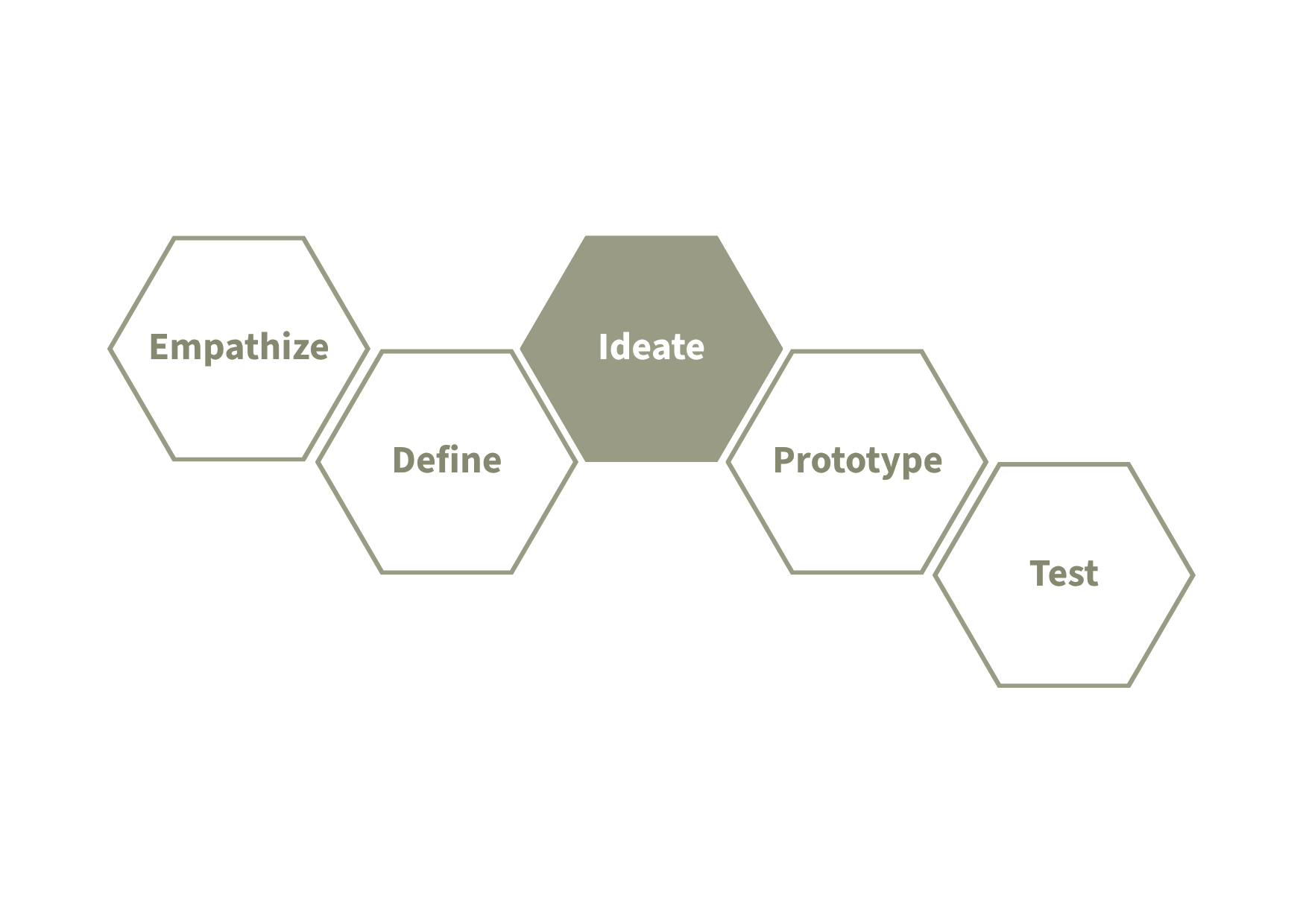
In the ideation phase, I had planned to use a digital whiteboard as the shared space for developing ideas. The workshop took place on Zoom, and the aim was to make the process visual, collaborative, and easy to follow.
But as often happens in real design work, the planned setup did not fully match the situation. The whiteboard was difficult to access, the internet connection was unstable, and I had to adjust the workshop as we went along. Instead, I moved between screen sharing, spoken facilitation, and a shared document to keep the conversation going.
What first seemed like a practical disruption became an important insight. It showed me that postdigital design is about designing across the messy realities where learning and leadership actually happen: through people, tools, materials, relationships, and everyday work.
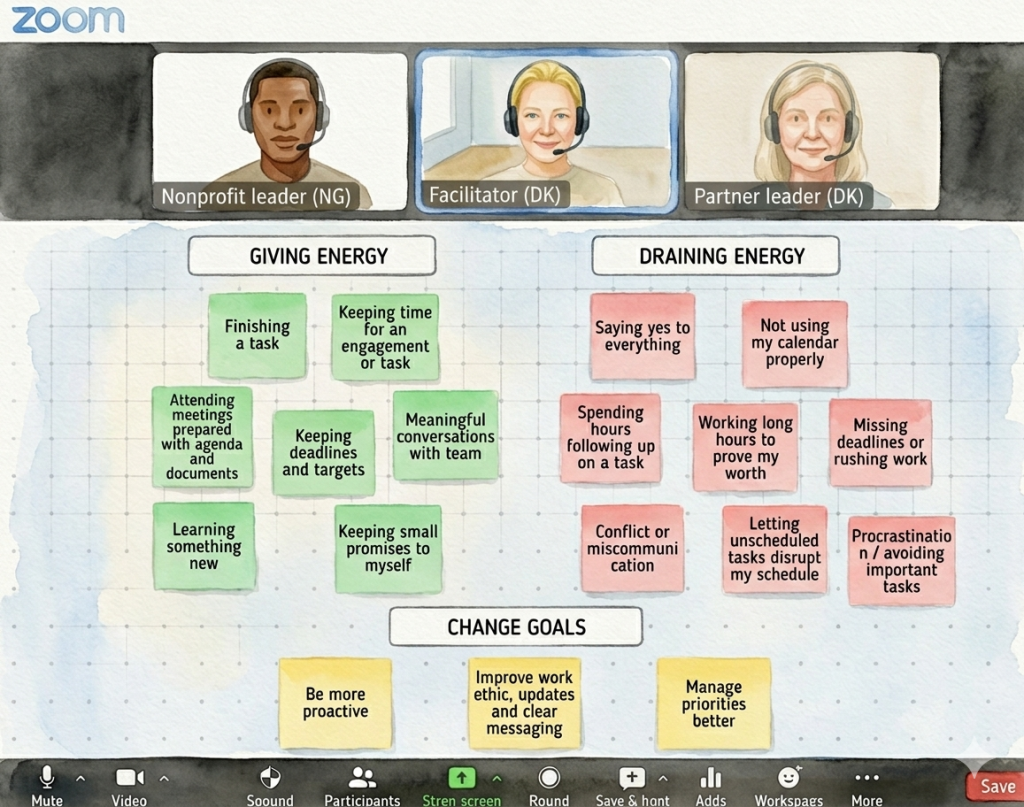
Future Workshop & Brainstorm
To move from the design challenge toward possible design directions, I did, despite challenges, manage to facilitate a short ideation workshop inspired by the Future Workshop method and Brainstorm as a design ideation method. Participants were the Nigerian nonprofit leader who I am designing for and the leader of his Danish partner nonprofit.
The Future Workshop helped structure the conversation around three movements: first identifying current frustrations, then imagining a more desirable future, and finally exploring what kinds of support could help move from the current situation toward that future. After this, I used Brainstorm as a way to open up the solution space. The aim was not to decide on a final design immediately, but to generate several possible ideas without judging them too early.
Three main findings emerged from the ideation process:
- A need for clearer direction and better prioritization
The leader expressed a need for support in clarifying what matters most and translating this into weekly priorities. This was not only about managing tasks more efficiently, but about taking on less, choosing more intentionally, and using a structure such as a priorities template to connect larger strategic direction with everyday scheduling. - A need for boundaries and support in saying no
Boundaries returned as a central concern in the ideation process. The leader needs support not only to plan his time, but also to protect it. This suggests that the design should include tools or prompts that help him say no, manage competing demands, and make decisions based on realistic capacity rather than immediate pressure. - A need for better delegation, communication, and follow-up
Delegation and follow-up were also identified as key areas. The leader needs support in assigning tasks clearly, building trust in others, tracking meeting outcomes, and following up on responsibilities. This points to a design that should not only support personal planning, but also strengthen the relational and communicative practices around leadership work.
Across the brainstorm, tools and templates appeared again and again, but they were always connected to something larger: a desire for practical learning, confidence, and professional development. Many of the leader’s reflections took the form of questions such as “How do I…?” or aspirations such as “I want to be able to…”. This suggests that the design should offer more than practical tools. It should also help the leader learn how to use them in ways that make sense in his everyday work.
At the same time, he did not point to one specific digital or analogue tool as the obvious solution. For me, this was an important finding. A postdigital leadership-learning ecology cannot assume that the leader already knows how to use productivity systems, planning templates, or digital workflows. Instead, it should give him room to explore, adapt, and gradually make the tools and routines his own, in ways that fit his everyday leadership context.


Skriv et svar
Du skal være logget ind for at skrive en kommentar.