Forfatter: Ruth

  • Design Principles #2

    Design Principles #2

    The ideation workshop pointed to three main needs: clearer direction and prioritization, support for boundaries and saying no, and better delegation, communication, and follow-up. These are practical needs, but they also show something larger. The design can’t simply be a planner, a template, or a digital tool. It needs to become a small self-leadership-learning ecology: something that helps the leader learn new ways of working while actually doing his everyday work.

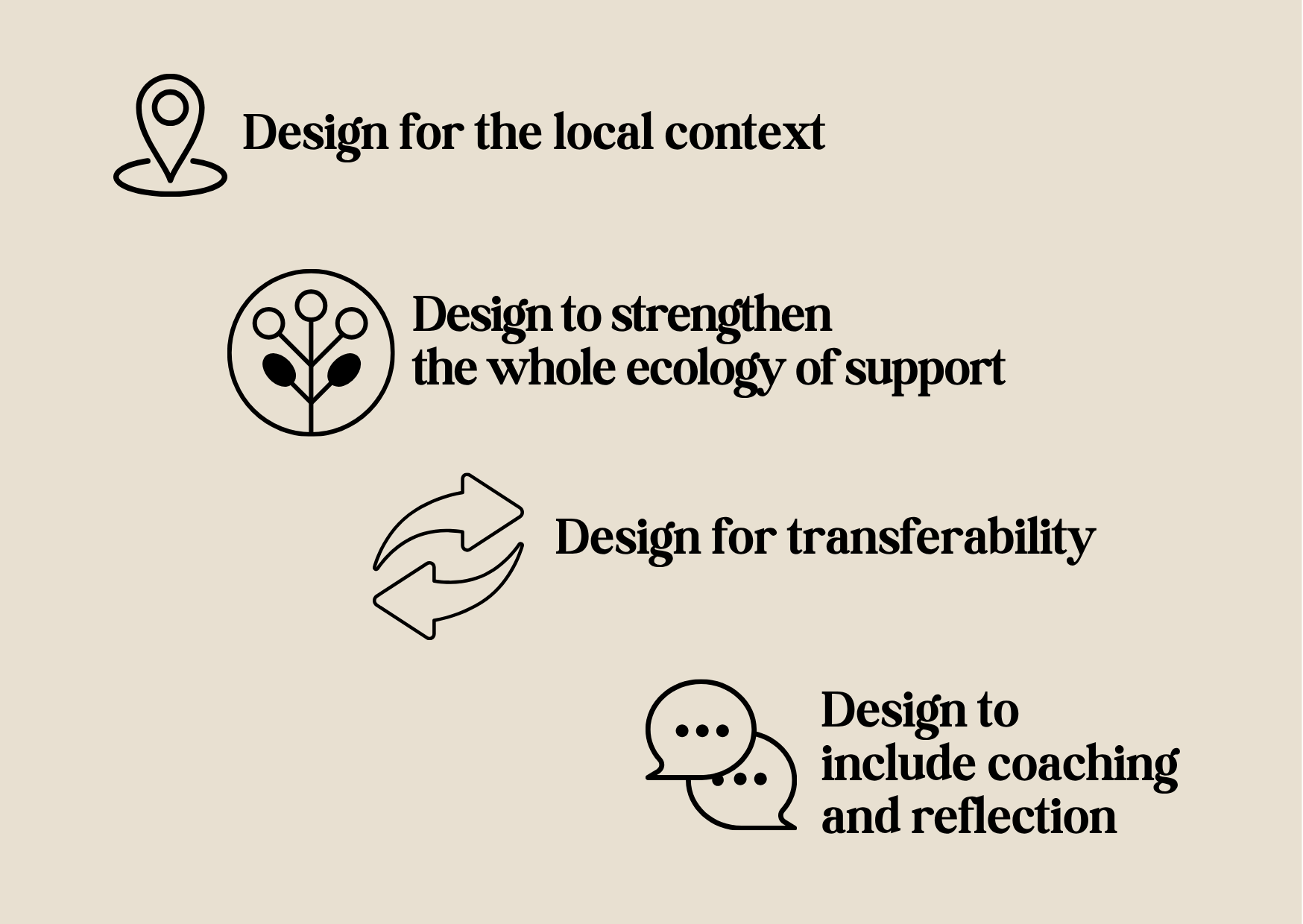
    My first design principles were quite broad. They focused on the local context, the wider ecology of support, transferability, and the importance of coaching and reflection.

    After the ideation workshop I realized the design still needs to be context-sensitive and postdigital, but it also needs to be more practical and more focused on learning through use. The leader does not only need tools, he also needs support in learning how to use tools and routines in a way that fits his actual work life.

    This matters because I don’t want to design for an ideal user with stable internet, plenty of time, and previous experience with productivity systems. I want to design for the real conditions of local nonprofit leadership: interruptions, limited resources, mixed communication channels, uneven digital access, and many competing responsibilities.


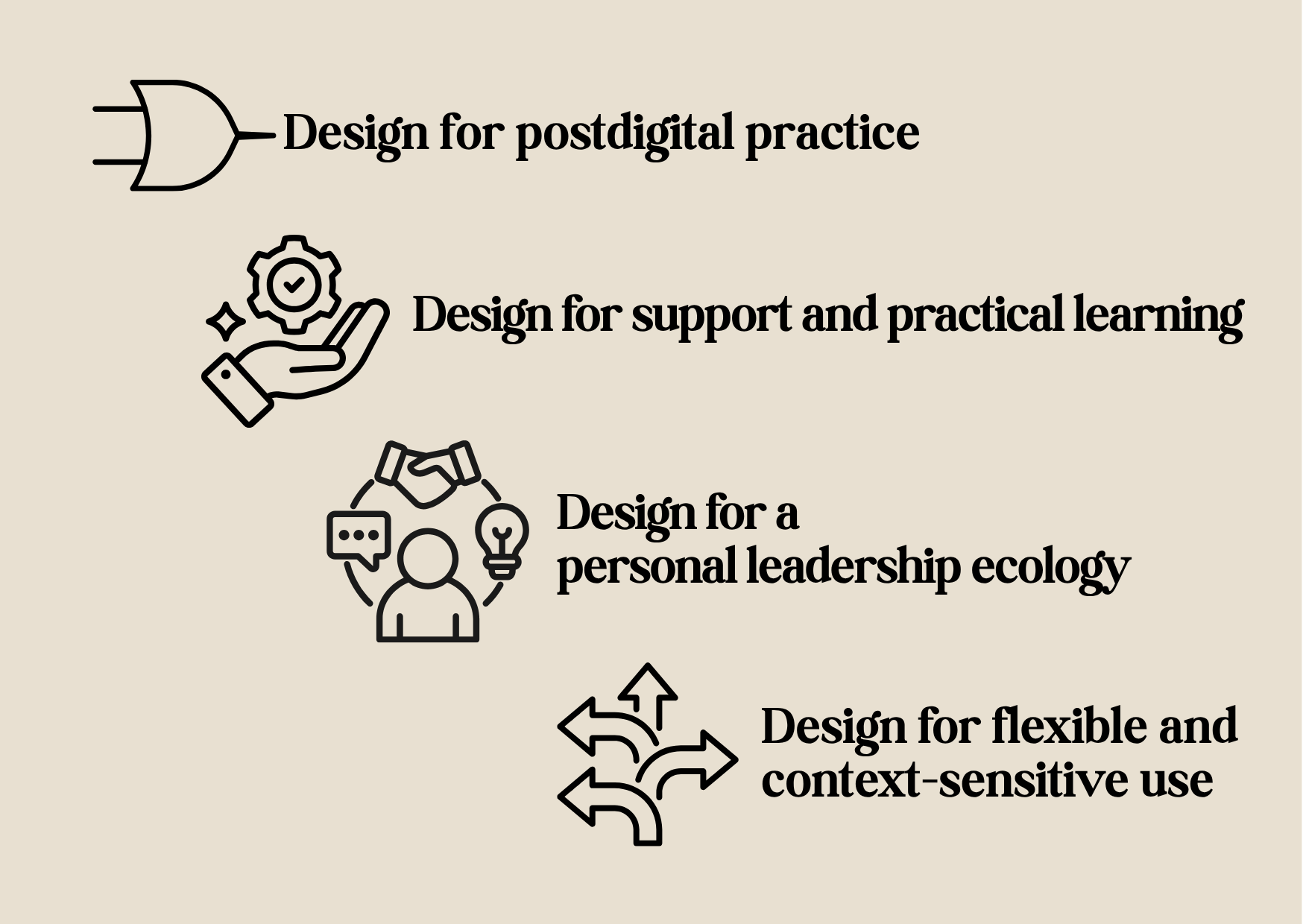
    This has led me to four revised design principles.

    #2.1: Design for postdigital practice, not digital tools alone

    The design should not treat the digital as a separate solution. It should connect digital tools with paper-based supports, physical routines, conversations, and reflection.

    This principle comes directly from the ideation process itself. The workshop did not unfold through one smooth digital platform, but moved between Zoom, screen sharing, spoken facilitation, and a shared document. In the same way, the design should not depend on one perfect tool. It should work with the mixed digital, material, and social reality of the leader’s everyday work.

    #2.2: Design for support and practical learning

    The design should not assume that the leader already knows how to use productivity methods, planning templates, or digital workflows. Instead, it should help him gradually explore, adapt, and make the tools his own.

    This principle became clearer during the brainstorm. Tools and templates were mentioned several times, but always alongside a broader desire for practical learning. The design should therefore support the leader in exploring and experimenting while building his personal leadership learning ecology.

    #2.3: Design for individual learning in a personal leadership ecology

    The design should support the leader’s individual learning over time. It should function as a practical home base for developing self-leadership through planning, reflection, experimentation, and follow-up.

    This principle helps keep the focus clear. In the ideation workshop, the leader expressed a clear wish to develop his personal leadership. He identified “saying yes to everything” as his biggest challenge and connected it to a need for stronger self-leadership. At the same time, his leadership is always practiced in relation to others: employees, board members, donors, and beneficiaries. The design should therefore support his individual learning and self-leadership, while still recognizing the relational nature of his work.

    #2.4: Design for flexible and context-sensitive use

    The design should be usable under uneven and changing conditions. It should work when the internet is unstable, when time is limited, and when work moves between online and offline spaces.

    This principle is important because the ideation workshop showed that the design cannot rely on ideal conditions. It should be flexible enough to move between digital and analogue formats, and simple enough to remain useful across different working conditions.


    The ideation phase helped me see that the design should not be a finished system handed over to the leader. It should be something he can grow into, test, adapt, and make his own.

    For me, this is where the postdigital perspective becomes practical. It is not only a theory about digital and non-digital learning. It is a way of designing for real life: where tools fail, people improvise, learning continues, and good design has to move with the situation.

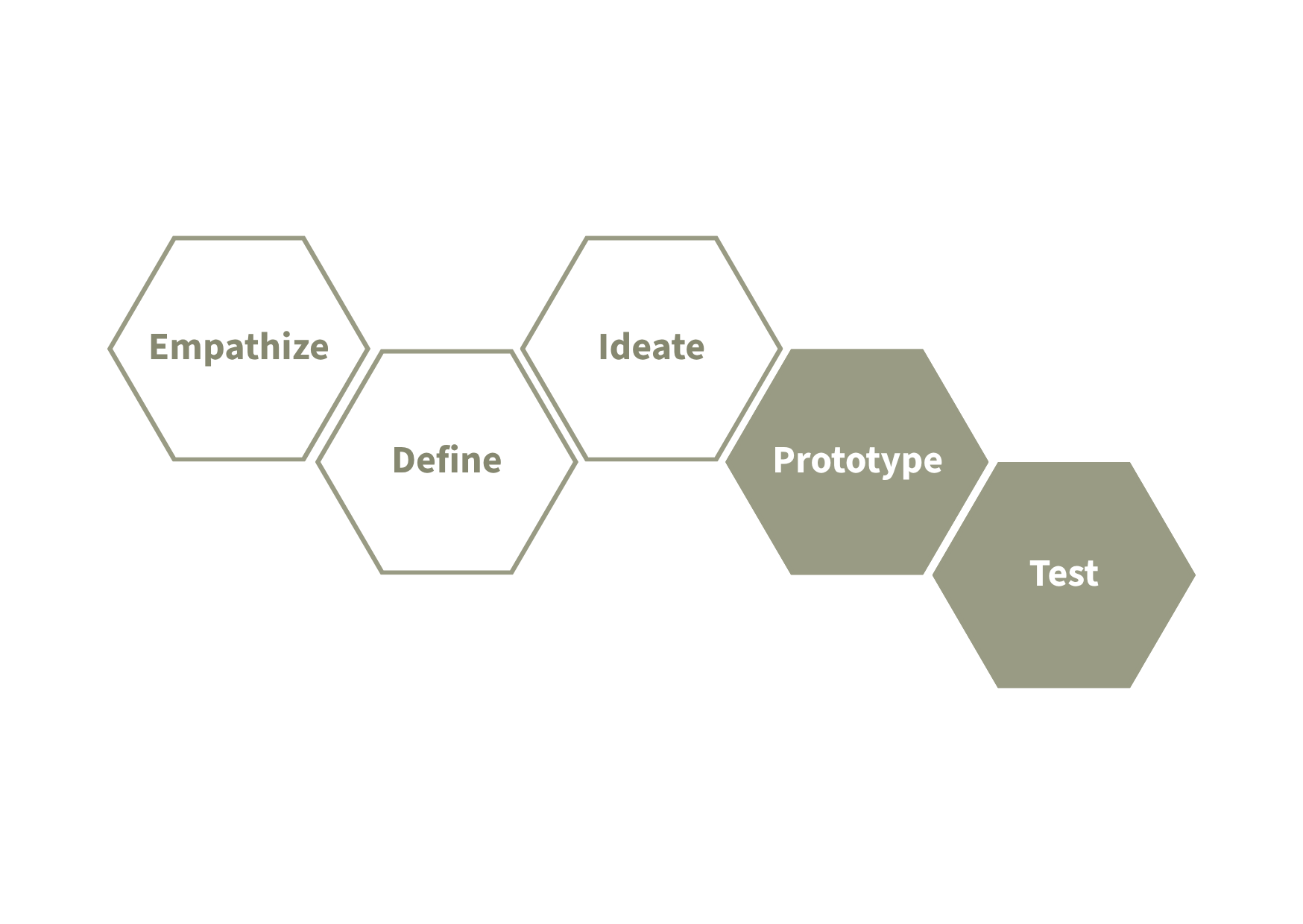
    My next step is to turn these principles into a first prototype. The challenge will be to make something simple enough to use, but rich enough to support real learning and change over time.

  • When the Whiteboard Wouldn’t Load: 
Ideating a Postdigital Leadership-Learning Ecology

    When the Whiteboard Wouldn’t Load: Ideating a Postdigital Leadership-Learning Ecology

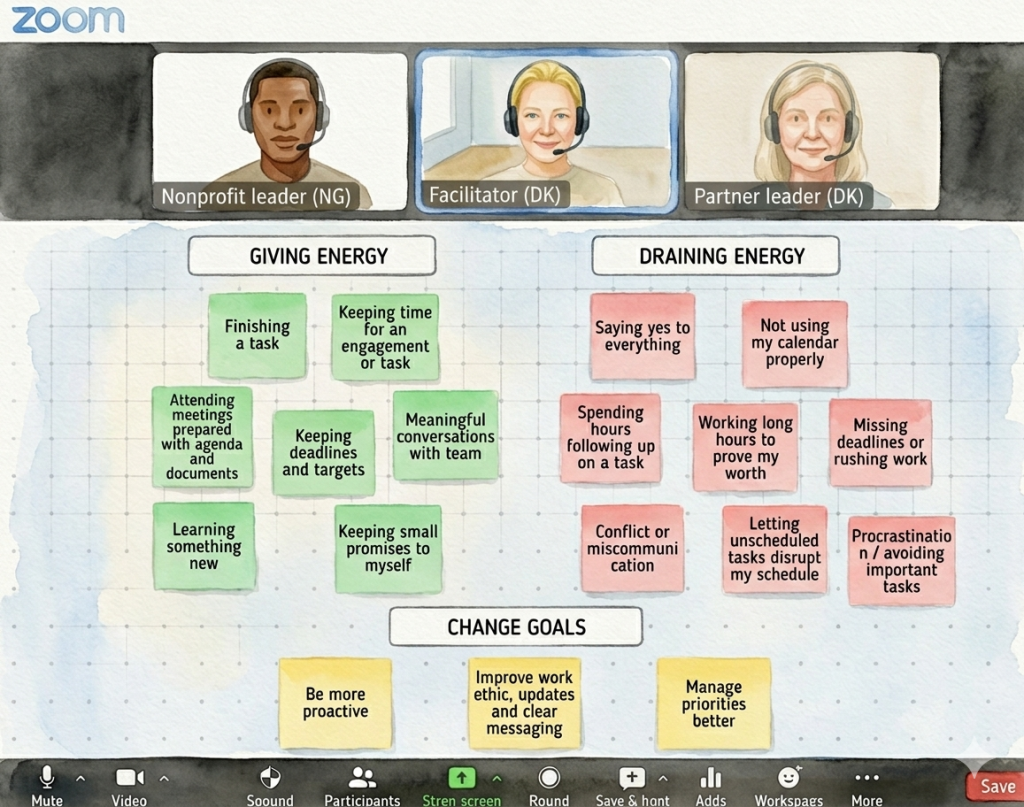
    In the ideation phase, I had planned to use a digital whiteboard as the shared space for developing ideas. The workshop took place on Zoom, and the aim was to make the process visual, collaborative, and easy to follow.

    But as often happens in real design work, the planned setup did not fully match the situation. The whiteboard was difficult to access, the internet connection was unstable, and I had to adjust the workshop as we went along. Instead, I moved between screen sharing, spoken facilitation, and a shared document to keep the conversation going.

    What first seemed like a practical disruption became an important insight. It showed me that postdigital design is about designing across the messy realities where learning and leadership actually happen: through people, tools, materials, relationships, and everyday work.

    Anonymized AI generated Image of the Online Workshop

    Future Workshop & Brainstorm

    To move from the design challenge toward possible design directions, I did, despite challenges, manage to facilitate a short ideation workshop inspired by the Future Workshop method and Brainstorm as a design ideation method. Participants were the Nigerian nonprofit leader who I am designing for and the leader of his Danish partner nonprofit.

    The Future Workshop helped structure the conversation around three movements: first identifying current frustrations, then imagining a more desirable future, and finally exploring what kinds of support could help move from the current situation toward that future. After this, I used Brainstorm as a way to open up the solution space. The aim was not to decide on a final design immediately, but to generate several possible ideas without judging them too early.

    Three main findings emerged from the ideation process:

    1. A need for clearer direction and better prioritization
      The leader expressed a need for support in clarifying what matters most and translating this into weekly priorities. This was not only about managing tasks more efficiently, but about taking on less, choosing more intentionally, and using a structure such as a priorities template to connect larger strategic direction with everyday scheduling.
    2. A need for boundaries and support in saying no
      Boundaries returned as a central concern in the ideation process. The leader needs support not only to plan his time, but also to protect it. This suggests that the design should include tools or prompts that help him say no, manage competing demands, and make decisions based on realistic capacity rather than immediate pressure.
    3. A need for better delegation, communication, and follow-up
      Delegation and follow-up were also identified as key areas. The leader needs support in assigning tasks clearly, building trust in others, tracking meeting outcomes, and following up on responsibilities. This points to a design that should not only support personal planning, but also strengthen the relational and communicative practices around leadership work.

    Across the brainstorm, tools and templates appeared again and again, but they were always connected to something larger: a desire for practical learning, confidence, and professional development. Many of the leader’s reflections took the form of questions such as “How do I…?” or aspirations such as “I want to be able to…”. This suggests that the design should offer more than practical tools. It should also help the leader learn how to use them in ways that make sense in his everyday work.

    At the same time, he did not point to one specific digital or analogue tool as the obvious solution. For me, this was an important finding. A postdigital leadership-learning ecology cannot assume that the leader already knows how to use productivity systems, planning templates, or digital workflows. Instead, it should give him room to explore, adapt, and gradually make the tools and routines his own, in ways that fit his everyday leadership context.

  • About Me

    About Me

    Hi, I’m Ruth. I’m a coach, student, and curious designer of learning experiences. Originally from Denmark and currently based in Bangkok, I work at the intersection of leadership development, coaching, and educational design.

    In my professional work, I support people in growth, reflection, and change. Right now, I am especially interested in leadership development and capacity building for local nonprofit leaders in the Global South. Through both my coaching work and my studies, I keep returning to the same question: how can we create learning and support that is practical, human, and meaningful in real everyday contexts?

    I am currently studying IT-based educational design at Aarhus University, where I explore how digital tools, relationships, and learning practices can come together in thoughtful and useful ways.

  • Design Principles

    Design Principles

    Designing for Stronger Local Leadership: My Design Principles

    At this point in the project, I have realised that I am not simply designing a tool. I am trying to design a postdigital leadership-learning ecology — a way of supporting self-leadership, follow-up, and reflection within the realities of everyday nonprofit work, and one that can still be useful through a transition toward building a new nonprofit initiative. I like this framing because it moves the project beyond the idea that leadership development happens in a separate “digital” space. Instead, it allows me to focus on how support can emerge through the interplay of digital tools, material artefacts, and relational practices in everyday life.

    This understanding forms the foundation for my design principles. If I am designing a postdigital leadership-learning ecology rather than a single tool, then the design needs to respond to the wider realities of leadership practice: the local context, the surrounding support system, the possibility of transition, and the need for reflection. The following design principles are my first attempt to translate these insights into concrete directions for the design.

    Design principle 1: Design for the local context

    This design should grow out of the Nigerian leadership context it is meant for, rather than importing assumptions from Danish or Western organizational culture. It needs to fit local realities, work rhythms, and everyday practices, so that the support feels relevant, realistic, and usable in practice.

    Design principle 2: Design to strengthen the whole ecology of support

    The design should not only support the individual leader, but also strengthen the wider ecology around him: the tools, routines, relationships, and structures that shape daily leadership work. This means designing for better coordination, clearer follow-up, and a more connected support system rather than focusing on the individual alone.

    Design principle 3: Design for transferability

    Because the leader is moving through a transition, the design should be useful not only in the current organization but also in a future nonprofit initiative. It should therefore be flexible, portable, and simple enough to travel across contexts without losing its value.

    Design principle 4: Design to include coaching and reflection

    The design should make space for reflection and coaching as part of everyday leadership practice, not as something separate from it. By supporting pauses for reflection, learning, and follow-up, the design can help strengthen self-awareness, accountability, and more sustainable leadership development.


  • Design Challenge

    Design Challenge

    Designing for Stronger Local Leadership: A Postdigital Design Challenge

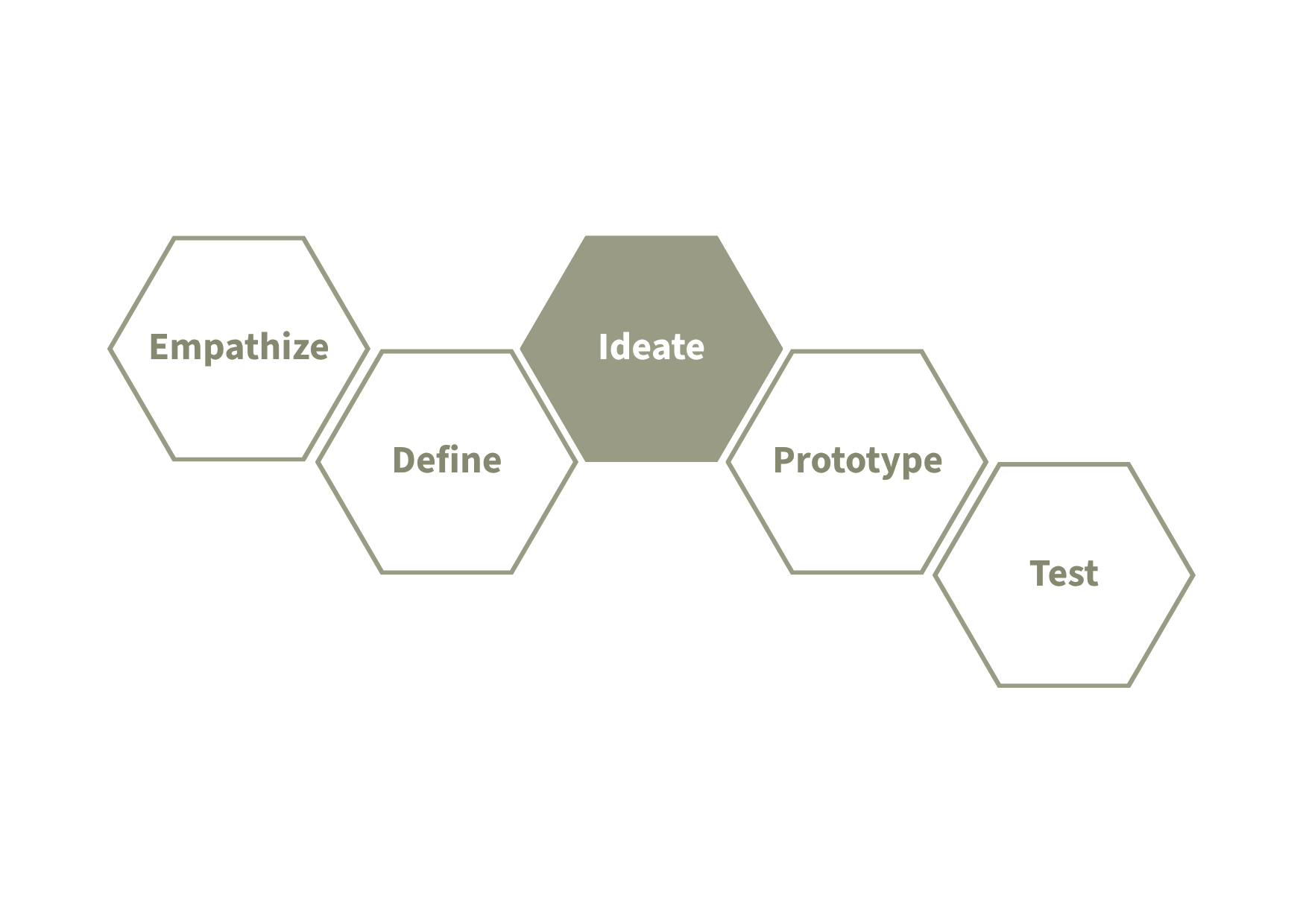
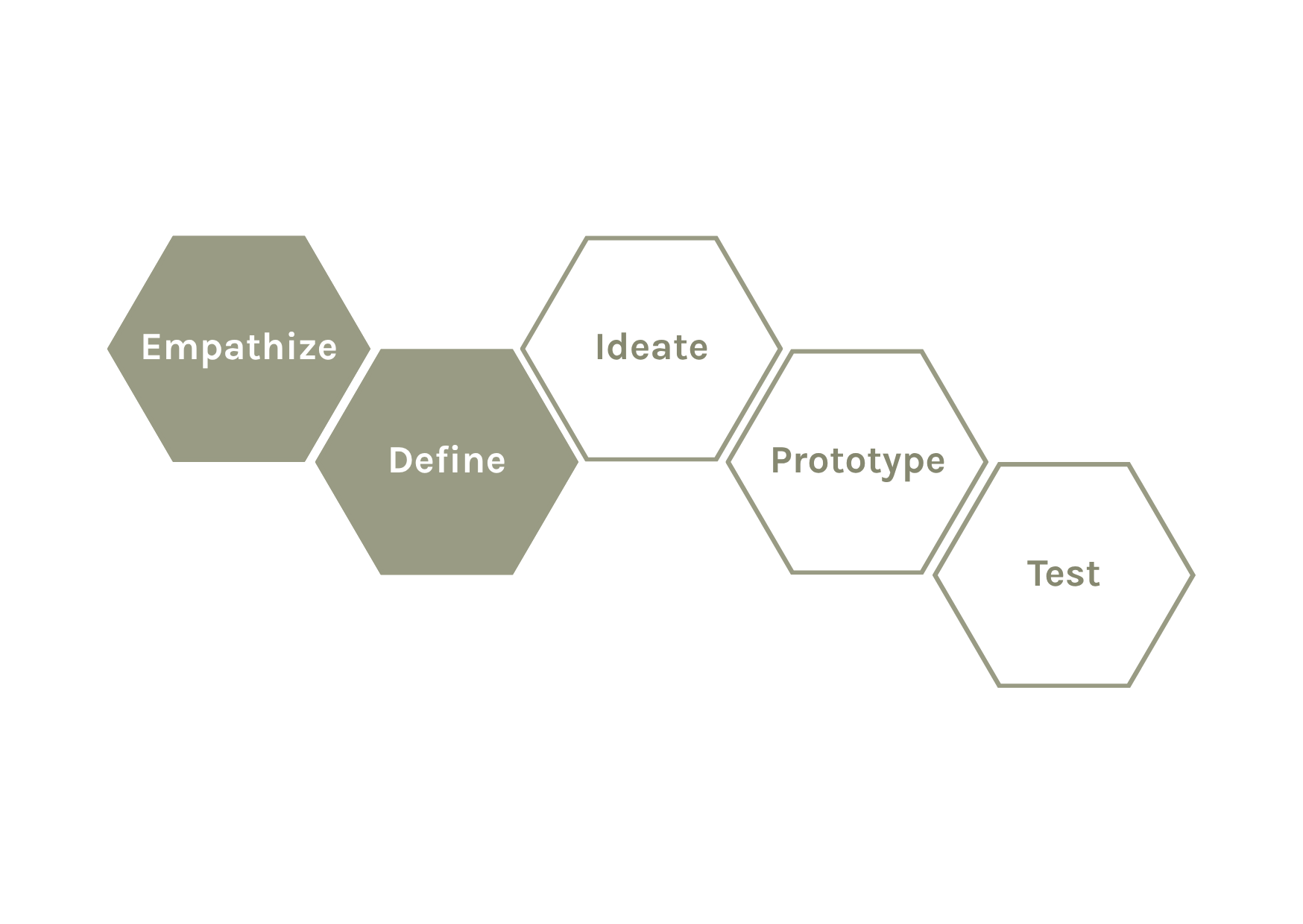
    For this design project, I have chosen to work with the Stanford model of design thinking because it offers a clear and human-centered way of moving from understanding a real context to developing possible design responses. In this blog post, I focus on the first two phases of the model: Empathize, where I explore and understand the user’s situation, and Define, where these insights are shaped into a more focused design challenge.

    Empathize

    In the Empathize phase, my goal has been to understand the everyday reality of the person and practice I am designing for. This is not only about collecting opinions, but about paying attention to the gap between what is said, what is done, and what the wider context makes possible.

    My empathy work has centered on an exploratory case study of a local nonprofit leader in Nigeria who works in partnership with a nonprofit organization in Denmark.  Its purpose was to generate insight into what it means to be a local nonprofit leader and to better understand the challenges and opportunities that may arise when leaders in the Global South collaborate with organizational partners in the Global North.

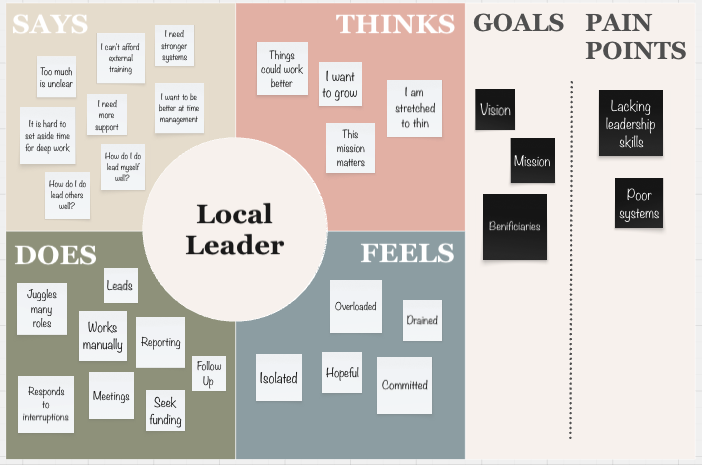
    To better understand this context, I have drawn on qualitative interviews, document analysis, and The Culture Map by Erin Meyer as an analytical lens. The findings were gathered in an empathy map in Miro as a visual synthesis tool to organize and interpret insights from the empirical investigation:

    What began to emerge was a picture of a leader who is deeply committed, values-driven, and motivated by the mission of his organization, but who is also carrying significant responsibility under difficult structural conditions. A key finding from the case interviews concerns self-leadership: 

    “I want to get better at scheduling. I don’t think my current system is effective. I also want to have the discipline to stick to what I have scheduled.”(…)“I want to understand better how to follow up.” – Nigerian nonprofit leader.

    For the local leader the area of personal productivity seems to be a focus area for growth. However, both The Culture Map and the interviews show cultural differences of how work is done in Nigeria versus Denmark. In this case, the Danish side tends to work with stronger expectations around calendars, deadlines, and step-by-step planning, while the Nigerian context appears more flexible and reactive. This does not mean that one approach is better than the other. Rather, it suggests that any design should be grounded in the local Nigerian leadership context instead of being built on imported assumptions about how work “should” be organized.

    Define

    The Define phase is where empathy begins to take shape as direction. After exploring the context more openly, I now need to ask: what is the actual challenge this project should address?

    What stands out most clearly in my case is a repeated tension between strong motivation and weak systems. The leader wants to become better at scheduling, follow-up, and everyday structure, but his current workflow depends on a patchwork of tools and habits: calendar use, paper notes, weekly review practices, wall planning, and retrieving documents through email threads. This suggests that the problem is not simply that there is “no system,” but that the existing system is fragmented, difficult to sustain, and hard to build on over time.

    The literature review helped sharpen this understanding even further. Across the sources I have reviewed, three themes stand out. First, leadership development needs to be context-sensitive. Second, it has to be understood as more than technical training. Third, it should be designed as a social and postdigital process shaped by people, tools, practices, and material conditions. In this case, that is especially important because the leader is also in transition toward building a new nonprofit initiative. The design therefore needs to be useful in his current work, while also being transferable enough to support him in a new organizational setting.

    From this case study, I have formulated the following design challenge:

    How might I design a postdigital leadership-learning ecology that supports self-leadership, follow-up, and reflection in current nonprofit work and through a transition toward building a new nonprofit initiative?

    And the following research question:

    How can a postdigital support ecology of digital tools, material artefacts, and relational practices strengthen self-leadership and everyday workflow for a local nonprofit leader in transition?

    Together, the design challenge and research question reflect a shift in how I understand the project. Rather than seeing leadership support as an individual problem to fix, I am beginning to see it as something shaped by tools, routines, relationships, and context. In my next post, I will build on this by presenting my first draft of design principles.